In recent years, with an increasingly improved business environment and more comprehensive investment support policies, Vietnam has become an attractive destination for foreign investors to establish FDI companies in Vietnam. The establishment of a joint-venture company (FDI) in Vietnam not only requires a thorough understanding of legal regulations but also accurate assessment of opportunities and challenges arising from the local business environment. As professional legal advisors, we are committed to providing up-to-date information and optimal investment strategies to help clients achieve sustainable success in investing and developing in the Vietnamese market.
Overview of FDI Enterprises
According to current legislation under the Law on Investment 2020, there is no specific definition of foreign-invested enterprises (FDI). Instead, the law introduces the concept of foreign-invested economic organizations under Article 3, which provides:
“Foreign-invested economic organization means an economic organization with foreign investors as its members or shareholders.”
Accordingly, a foreign-invested enterprise is one form of foreign-invested economic organization, regardless of the percentage of foreign capital contributed. Foreign direct-investment enterprises include:
– Enterprises with 100% foreign capital.
– Enterprises in which foreign individuals or organizations established under foreign laws invest (capital contribution, capital acquisition).
Conditions for Establishing an FDI Company in Vietnam
To establish an FDI enterprise, investors must ensure that they meet the following conditions:
Conditions for foreign investors contributing capital from the beginning to establish an economic organization
Pursuant to Article 22 of the Law on Investment 2020:
Foreign investors establishing an economic organization must satisfy the market-access conditions applicable to foreign investors set out under Article 9 of this Law.
Before establishing the economic organization, foreign investors must have an investment project and carry out procedures for issuance or adjustment of the Investment Registration Certificate, except for cases involving the establishment of small and medium-sized innovative start-up enterprises or innovative start-up investment funds under regulations on SME support.
Conditions for foreign investors contributing capital, purchasing shares, or acquiring capital contributions
Foreign investors contributing capital, purchasing shares, or acquiring capital contributions in an economic organization must satisfy the following:
Market-access conditions applicable to foreign investors under Article 9 of the Law on Investment 2020;
National defense and security requirements under the Law on Investment 2020;
Land-related regulations concerning eligibility to receive land-use rights, especially in islands, border communes/wards/towns, or coastal areas.
In addition, under Decree 31/2024/NĐ-CP, the State also provides a list of sectors and conditions on market access applicable to foreign investors.
Conditions regarding the legal capacity and nationality of foreign investors
Eligible foreign investors may include individuals above 18 years of age, organizations, and enterprises of WTO member states or nations that have signed bilateral investment treaties with Vietnam. However, certain business sectors allow only foreign investors who are legal entities to participate. Individual investors holding passports with the “nine-dash line” content are prohibited from contributing capital or acting as authorized representatives managing foreign investment portions in Vietnam.
There is no specific regulation restricting investor nationality. Investors from any country may invest in Vietnam provided that they comply with applicable laws and international treaties to which Vietnam is a party.
Detailed provisions on subjects and nationality of foreign investors can be found in the Law on Enterprises, the Law on Investment, and other relevant regulations governing foreign investment in Vietnam.
Financial capacity requirements for foreign investors
Foreign investors must possess adequate financial capacity for investment activities and must submit evidence of financial capability depending on the chosen investment sector.
Requirements for the registered company headquarters and project location
Foreign investors must secure a project implementation site in Vietnam through a location lease contract, house/land lease agreement, or other lawful property documents to serve as the company’s headquarters and project location.
For manufacturing projects, investors must demonstrate eligibility to lease factories and provide a factory lease agreement in industrial parks or clusters.
Requirements regarding experience and specific conditions under the investment sector
Foreign investors establishing FDI companies in Vietnam must satisfy sector-specific conditions applicable to conditional business sectors.
Additionally, foreign investors must ensure that they do not fall within prohibited business sectors under Article 6 of the Law on Investment 2020, including:
Trading in prohibited substances listed under Appendix I
Trading in prohibited chemicals under Appendix II
Trading in wildlife specimens sourced from nature listed under the CITES Convention and Appendix III
Prostitution business
Trafficking of persons, human organs, tissues, fetuses
Commercial surrogacy activities
Trading in fireworks
Debt-collection services
Forms of Establishing an FDI Company in Vietnam
In Vietnam, foreign investors can establish FDI enterprises via two methods: direct investment and indirect investment, each subject to specific conditions:
– For direct investment, foreign investors establishing companies with foreign capital or 100% foreign-owned companies must satisfy conditions under Article 22 of the Law on Investment 2020.
– For indirect investment, investors contribute capital or acquire shares/capital contributions in a Vietnamese company (in simple terms: a company is first established with 100% Vietnamese capital, then shares are transferred to foreign investors). Conditions for this type of investment are provided under Article 24(2) of the Law on Investment 2020.
Process of Establishing an FDI Company in Vietnam
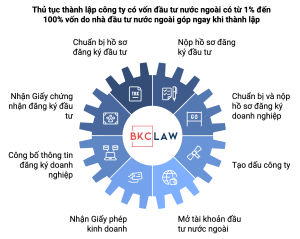
Process of establishing an enterprise with foreign-invested capital from 1% to 100% at the time of formation
Process of establishing an enterprise with foreign-invested capital from 1% to 100%
Step 1: Prepare documents for the Investment Registration Certificate
To obtain the Investment Registration Certificate (IRC), foreign investors must prepare:
Application for investment project implementation;
Documents proving legal status:
Depending on investor type:
For institutional investors: a copy of the Certificate of Incorporation or equivalent legal document;
For individual investors: a copy of the ID card/Citizen ID/Passport.
Investment project proposal including: investor information, project objectives, scale, capital and capital-raising plan, location, duration, implementation schedule, labor needs, proposed investment incentives, and socio-economic impact assessment.
Documents proving financial capacity:
For institutional investors: audited financial statements for the last 02 years or financial support commitments from the parent company/financial institution or financial-capacity guarantee.
For individual investors: bank balance confirmation, savings book, etc.
Documents showing legal rights to use the project site: lease contract, land-use right certificate, construction permit, zoning approvals, land-allocation/lease decision, etc.
Proposal for land-use needs for the project
Technology-use explanation if applicable, including technology name, origin, technological diagrams, key technical specifications, equipment conditions, etc.
Step 2: Submit the application for the Investment Registration Certificate
For projects not subject to investment policy approval:
The investor declares project information online via the National Foreign Investment Information System before submitting the application. The official application must be submitted within 15 working days after online declaration.
After the application is received, the investor receives an account to track processing status. The authority will process and issue project code via the system.
Step 3: Issuance of the Investment Registration Certificate
Within 15 working days from the date of receiving a complete application, the competent authority will issue the IRC. If the application is rejected, the authority must respond in writing with clear reasons.
Step 4: Prepare and submit documents for the Enterprise Registration Certificate (ERC) to establish the FDI company
After receiving the IRC, investors must apply for the ERC similar to establishing a Vietnamese-owned company.
ERC documents include:
Application for enterprise registration;
Company charter;
List of members or shareholders;
Copies of ID/Passport of individuals;
Decision on establishment, Business Registration Certificate, or equivalent—all with authorization—for organizational investors;
For foreign institutional members: legalized copy of Business Registration Certificate;
Investment Registration Certificate.
Step 5: Publish enterprise registration information
After being granted the ERC, the company must publicly disclose information through the National Business Registration Portal and pay the publication fee.
Published information includes business sectors, list of founding shareholders, and foreign shareholders (if applicable).
Failure to publish or publishing incorrect information is subject to penalties under Decree 122/2021/NĐ-CP.
Step 6: Company seal engraving
The seal may be a physical seal or a digital signature. The enterprise decides seal quantity, type, form, and content.
Seal management follows the company charter or internal regulations.
Step 7: Obtain business licenses or operational permits
Business licenses are required for retail activities or establishing retail outlets. Some sectors require specialized permits such as food safety, environmental permits (food sector), education licenses, travel licenses, etc.
Conditions for obtaining a retail business license include:
Investor must be from a country/territory that has opened its market for goods trading under international treaties;
Compliance with market-access commitments;
· Having a financial plan;
No outstanding tax debt (if operating in Vietnam for at least 1 year).
Other considerations:
Compliance with sector-specific regulations;
Adaptation to domestic competitive conditions;
Job creation potential;
Contribution to state budget.
Process for retail business license application:
Application form;
Explanatory statement under Article 9 of Decree 09/2018/NĐ-CP;
Business plan (content, method, socio-economic impact);
Financial plan (audited reports, current financial status);
Tax clearance confirmation;
ERC and IRC (if applicable).
Processing time: approximately 30–45 working days by the Department of Industry and Trade.
Step 8: Open a direct investment capital account
This account is used to transfer contributed capital on schedule as stated in the IRC. The FDI company must also open a transaction account for local payments.
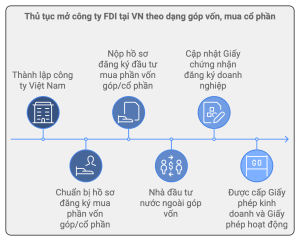
Process of establishing an FDI company in Vietnam through capital contribution or share acquisition
Process of establishing an FDI company in Vietnam through capital contribution or share purchase
Step 1: Establish a Vietnamese-owned company
Foreign investors can acquire shares only when a Vietnamese company exists. If the Vietnamese partner has not completed company establishment procedures, they must first establish a 100% Vietnamese-owned enterprise.
Step 2: Prepare the application for capital contribution/share acquisition
Required documents include:
Application for capital contribution or share/capital purchase, including detailed information on the economic organization receiving the investment and post-transaction ownership ratio of the foreign investor.
Copies of legal identity documents of individual investors. For institutional investors: Certificate of Incorporation or equivalent documents.
Agreement on capital contribution or share/capital acquisition between the foreign investor and the receiving economic organization.
0 (0) The merger of foreign enterprises into the Vietnamese market presents substantial opportunities but also encounters numerous challenges. Evaluating...
0 (0) With Vietnam’s rapidly developing economy and increasingly attractive investment environment, the country has drawn significant interest from foreign...
0 (0) <em><span id=”cke_bm_306S”> </span><strong>Resolution of Disputes Arising from Condominium Purchase and Sale in Binh Tan District</strong> is a prevalent legal...
0 (0) Investment consulting services in Vietnam are increasingly affirming their essential role in supporting investors—from individuals to organizations—in achieving...
0 (0) When confronting inheritance matters, understanding the fees for engaging a professional inheritance attorney is essential to safeguarding your...


.svg)
.svg)