M&A stands for Mergers and Acquisitions referring to corporate restructuring activities through the transfer of company control by way of acquisition or merger. M&A is also a common method chosen by foreign investors when entering the Vietnamese market, particularly in specialized or large-scale business sectors, allowing investors to quickly access and expand their operations in Vietnam.
However, M&A is a complex process that requires extensive expertise. M&A transactions in Vietnam often involve important legal issues such as market access conditions, foreign ownership limitations, investment approval procedures, and legal due diligence. This article provides an overview of the key legal issues relating to M&A transactions in Vietnam involving foreign investors acquiring equity interests.
Mergers and Acquisitions
Market Access Conditions for Foreign Investors
Pursuant to Clause 10 Article 3 of the Law on Invesment 2025, market access conditions for foreign investors refer to the requirements that foreign investors must satisfy when investing in sectors included in the List of Restricted Market Access Sectors. Foreign investors include foreign individuals and organizations established under foreign laws conducting investment and business activities in Vietnam.
Under Decree No. 96/2026/ND-CP, foreign investors are generally subject to the same market access conditions as domestic investors, except for sectors listed under the restricted market access list applicable to foreign investors. This list includes:
sectors where market access is prohibited; and
sectors subject to conditional market access.
Currently, Appendix I attached to Decree No. 96/2026/ND-CP provides for 62 sectors subject to conditional market access for foreign investors and 23 sectors where market access is not permitted. Market access conditions typically include:
Investment forms;
Foreign ownership ratio in the charter capital of economic organizations;
Scope of investment activities;
Capacity of investors and partners participating in the investment activities;
Other conditions prescribed under Vietnamese law.
Accordingly, determining the applicable market access conditions is a critical factor in assessing the feasibility and conditions for foreign investors to acquire shares or capital contributions in Vietnamese enterprises.
Financial Due Diligence and Legal Due Diligence
Legal Due Diligence
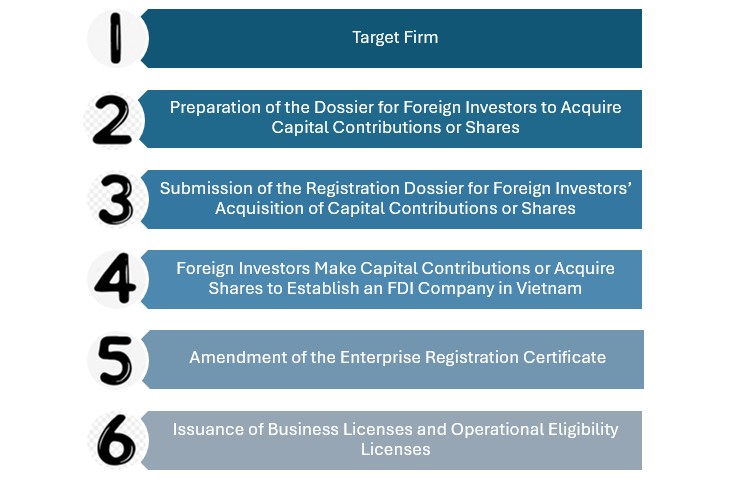
In M&A transactions, the term “Target Firm” refers to the enterprise selected by the investor or acquiring party for acquisition or merger purposes. Identifying the appropriate target company is a fundamental step, as it forms the basis for determining whether the M&A transaction should proceed.
Therefore, before carrying out the transaction, legal due diligence on the target company should be conducted to comprehensively assess its legal status and potential risks. The due diligence scope typically includes:
The establishment process and legal status of the enterprise;
Charter capital, capital structure, and capital contribution status of members/shareholders;
Assets owned or used by the enterprise;
Existing transactions and ongoing business projects;
Employment matters, personnel structure, and labor-related obligations;
Existing disputes, complaints, or legal risks.
A thorough review of these matters enables investors to fully identify potential risks, make informed investment decisions, and structure the transaction appropriately.
Financial Due Diligence
In addition to legal due diligence, investors should also conduct financial due diligence on the target company to accurately assess its financial condition, operational performance, and cash flow generation capability.
The objective of this process is to determine the company’s actual value, verify the transparency of financial data, and identify potential financial risks that may impact the investment decision.
Financial due diligence typically includes:
Financial statements for recent years;
Revenue, profit, and profit margins by business segment;
Cost structure and unusual expenses;
Accounts receivable, accounts payable, and debt recovery capability;
Tax obligations and other payable amounts to the state budget;
Actual cash flow and solvency of the enterprise;
Loans, financial obligations, and guarantee commitments (if any).
The results of financial due diligence help investors adjust the enterprise valuation, negotiate a more reasonable purchase price, and establish protective provisions in the M&A agreement.
Drafting the Dossier for Acquisition of Capital Contributions or Shares by Foreign Investors
Pursuant to Clause 3 Article 76 of Decree No. 96/2026/ND-CP, the registration dossier includes the following documents:
Application for registration of capital contribution, share purchase, or acquisition of capital contributions;
Documents evidencing the legal status of the individual or organization contributing capital, purchasing shares, or acquiring capital contributions, and of the economic organization in which the foreign investor contributes capital, purchases shares, or acquires capital contributions;
Agreement on capital contribution, share purchase, or acquisition of capital contributions;
Other relevant documents.
In addition to the above documents, depending on the specific circumstances, foreign investors and economic organizations may also be required to provide additional legal documents, such as documents evidencing the investor’s legal status, documents proving the current ownership ratio, powers of attorney, or explanatory documents regarding market access conditions and conditional business sectors applicable to foreign investors.
The preparation of the dossier must ensure completeness, accuracy, and consistency in order to minimize requests for amendment or supplementation from the investment registration authority.
M&A Procedure for Foreign Investors
Procedure for Acquisition of Capital Contributions or Shares by Foreign Companies in Vietnam
In conclusion, to ensure that an M&A transaction proceeds smoothly, investors should possess professional knowledge and a sound understanding of the key legal issues discussed above in order to efficiently implement the transaction and related procedures, thereby enabling the enterprise to commence operations promptly.
BKC Law provides consulting services and support for investment-related procedures in Vietnam. With a team of experienced lawyers and a professional working style, we are confident in being one of the leading legal partners in the market, assisting clients in completing procedures for establishing foreign-invested companies quickly and effectively.
0 (0) After establishing a foreign-invested enterprise in Vietnam, foreign investors must continue carrying out procedures for obtaining Business Licenses...


.svg)
.svg)