Recently, while advising foreign-invested restaurant chains in Vietnam on their expansion strategies, BKC has identified a highly debated legal hurdle concerning the Retail License. Specifically, many investors believe that operating a pure restaurant business inherently does not require this type of license. However, reality points to a very fragile boundary: when the business model expands to include the sale of takeaway products such as spices, packaged foods with expiration dates, or distribution via e-commerce platforms, the enterprise is obligated to undergo licensing procedures.
How are state management agencies defining the boundary between food and beverage services and goods retailing? What compliance risks must FDI enterprises be wary of to avoid penalties? Let’s break down this issue in detail with BKC below.
What is a Retail License?
A “Retail License”is the common term for a Business License, understood as a legal document issued by a competent state authority to an individual or organization, permitting them to conduct business activities in a specific field or industry according to the law. This license confirms that the enterprise has met the necessary legal conditions and is authorized to carry out business operations in compliance with regulations.
From the above concept, a Retail Business License is a type of license granted by the competent authority to foreign-invested companies, allowing them to conduct retail activities in the Vietnamese market, which includes the following two types:
-
Business License (permitting retail business activities)
-
License to establish a retail outlet
Does an eat-in restaurant require a Business License?
Under Decree No. 09/2018/ND-CP, retailing is defined as the activity of selling goods to individuals, households, and other organizations for consumption purposes. For a pure eat-in restaurant/eatery model, this activity is legally classified as the provision of food and beverage services (falling under CPC 642 and CPC 643 codes as per international commitments), not as the trading of goods.
Therefore, if the restaurant purely prepares food and beverages and serves diners strictly within the restaurant’s premises, the enterprise is not required to apply for a Business License (for retailing) or a License to establish a retail outlet. For this model, the primary legal compliance for investors revolves around conditions concerning the premises, food hygiene and safety, fire prevention and fighting, and environmental protection.
In what cases must an FDI restaurant apply for a Business License and a License to establish a retail outlet?
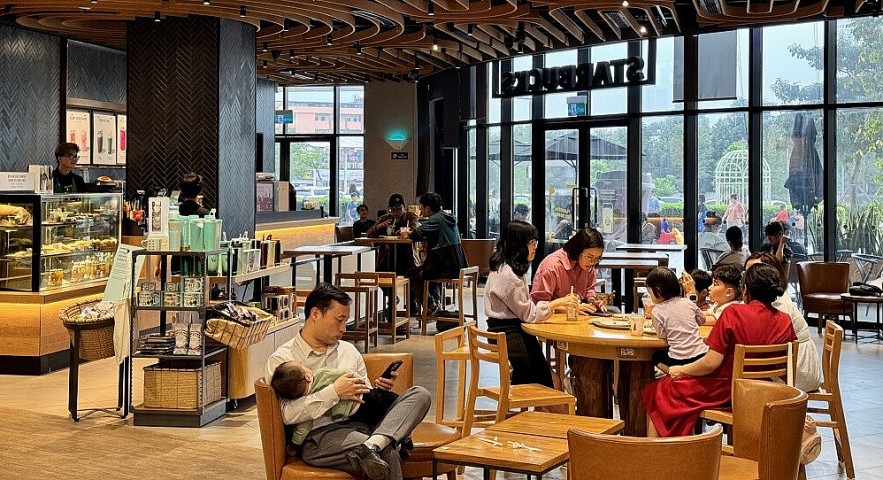
Although the core activity is providing food and beverage services, reality shows that many FDI restaurants often expand their models to optimize revenue by selling additional products manufactured or packaged by the restaurant directly to consumers. These products have expiration dates and standard labeling. Thus, according to Decree No. 09/2018/ND-CP, foreign investors are strictly required to apply for a license if any of the following activities arise:
-
Retailing of goods (takeaway packaged products): If the restaurant engages in the additional activity of displaying and selling commercial packaged products with expiration dates that bear the characteristics of goods (such as bottled sauces, spices, packaged coffee, pre-cooked meals, imported food, or selling bottled wine for takeaway), this constitutes the exercise of the retail distribution right. In this case, the FDI company must apply for a Business License.
-
Selling goods via E-commerce platforms (online sales): Similarly, if the restaurant not only serves on-site but also lists these packaged products for sale online, on its own website, or through delivery apps and e-commerce platforms, the enterprise needs a Business License featuring the industry code for retail distribution of food/beverages.
-
Applying for a License to establish a retail outlet: According to the definition specified in this Decree, a retail outlet is a location where retail activities take place. An FDI enterprise has the right to request this license after obtaining a Business License. From the regulators’ perspective, when a restaurant directly conducts transactions, displays, and delivers tangible retail goods to customers right on its premises, that location is considered a retail outlet. Therefore, alongside the Business License, the enterprise must apply for an additional License to establish a retail outlet specifically for that restaurant location.
Legal risks often overlooked by FDI enterprises
When expanding their chains and business models, foreign-invested F&B enterprises often encounter oversights that easily lead to penalties or operational suspension:
- First, confusing the boundary between Services and Retail: Many businesses subjectively assume that having registered for the restaurant business allows them to sell all culinary-related products. Utilizing a corner of the restaurant to open a souvenir counter, sell canned goods, or restaurant-branded spices without obtaining additional licenses is a common violation.
- Second, obtaining a Business License but forgetting the License to establish a retail outlet: For businesses that have previously obtained a Business License, when opening new restaurant locations that incorporate product displays and retail, they often overlook the procedure to apply for an additional License to establish a retail outlet for these expanded locations. The omission of this license becomes even more severe when the enterprise operates a chain. From the second retail-inclusive restaurant location onwards, the law terms this as establishing a retail outlet beyond the first retail outlet. Licensing these outlets does not just stop at standard dossier submission; in certain cases—such as retail outlets with an area of 500m^2 or more that are not located in commercial centers-the enterprise must also undergo an Economic Needs Test (ENT) evaluated by the provincial ENT Council. This is a complex and time-consuming procedure. Furthermore, many F&B enterprises mistakenly believe that a single Business License can be used for the entire restaurant chain. When competent authorities conduct physical inspections of the premises or check advertising information on the internet, discovering restaurant branches displaying and selling takeaway goods without the corresponding License to establish a retail outlet will result in administrative fines, forced removal of the stalls, or, more severely, business suspension.
- Third, the risk of inspection via online information: When reviewing licensing applications or conducting inspections, competent authorities do not solely rely on the physical dossiers submitted by the enterprise. They also cross-check information provided by the enterprise itself on the Internet, its Website, Fanpage, social media, or delivery apps. If a business heavily advertises the sale of packaged takeaway products online but in reality has not been granted a retail license, authorities have grounds to refuse other licensing procedures or impose penalties.
Thus, if solely engaged in on-site culinary services, an FDI restaurant does not need a retail license. However, once the restaurant participates in the commercialization of tangible products—such as selling packaged goods or selling via e-commerce platforms—the enterprise must strictly comply with regulations on goods distribution and is mandatorily required to possess both a Business License and a License to establish a retail outlet simultaneously.
Application dossier for a Business License:
After determining the licensing conditions and the specific characteristics of the business sector, the enterprise will proceed to develop a business plan and finalize the necessary legal documentation. During this phase, it is required to prepare a dossier applying for a Retail Business License as stipulated in Article 12 of Decree No. 09/2018/ND-CP, including:
- An application form for a Business License (Form No. 01 attached to the Decree);
- An explanatory report;
- Documentation from the tax authority proving there are no overdue tax debts;
- Copies of the Enterprise Registration Certificate and the Investment Registration Certificate.
Within this, the explanatory report for the Business License must clearly present the business plan, financial capacity, distribution network, and market impact. Competent authorities will rely on this report to evaluate the feasibility, suitability, and effectiveness of the investment project.
Additionally, the enterprise must fully prepare legal documents such as financial records, retail location lease agreements, and other related dossiers as required by the licensing authority to ensure a smooth appraisal and licensing process.
For legal consultation on the Business License application process and further advice on whether your specific case requires a business license, please contact BKCLAW’s attorneys via the following details:
-
Phone: 0909 073 692
-
Email: info@bkclaw.vn
-
District 1 Office: 9th Floor, Diamond Plaza Building, 34 Le Duan, Saigon Ward, Ho Chi Minh City
-
Binh Tan Office: 41 Ten Lua, An Lac Ward, Ho Chi Minh City
Không có tag nào
Khuyến Cáo:
Các thông tin trên chỉ mang tính tham khảo. Vui lòng liên hệ để được biết thông tin chi tiết


.svg)
.svg)