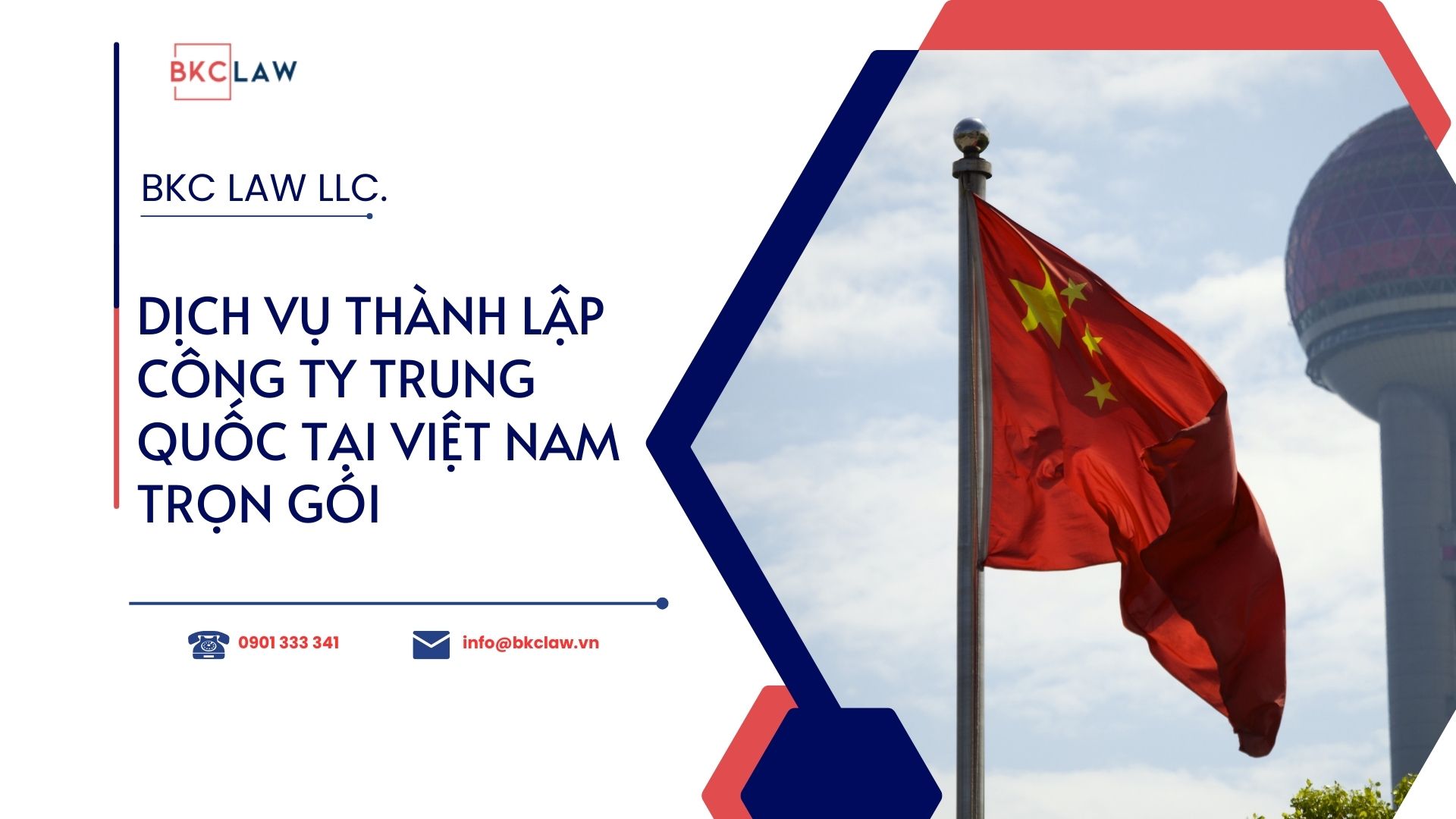
The establishment of Chinese companies in Vietnam is becoming a strong investment trend as the economic relationship between the two nations flourishes, especially given that Vietnam is an increasingly attractive destination for foreign direct investment (FDI). With the advantages of geographic location, an abundant workforce, reasonable production costs, and the government’s investment attraction policies, Vietnam serves as a highly potential market for Chinese enterprises seeking expansion. However, to ensure a successful and lawful investment process, Chinese enterprises must thoroughly grasp the conditions, procedures, and legal requirements for incorporating a company in Vietnam.
Governing Legal Framework
The primary legal regulations that Chinese investors must adhere to when establishing a company in Vietnam include:
- Law on Investment 2020 (Law No. 61/2020/QH14): This law governs domestic and foreign investment activities in Vietnam, encompassing regulations on investment sectors, specific conditions, and investment registration procedures.
- Law on Enterprises 2020 (Law No. 59/2020/QH14): This law regulates the establishment, organization, operation, and management of enterprises in Vietnam, specifically the incorporation of foreign-invested enterprises (FIEs), company operations, and the rights and obligations of shareholders and company members.
- Decree No. 31/2021/ND-CP guiding the Law on Investment: This decree provides detailed guidelines on the procedures and processes for issuing the Investment Registration Certificate for foreign investment projects, as well as regulations on the conditions and rights of foreign investors.
- Decree No. 01/2021/ND-CP on enterprise registration: This decree specifies the procedures and documentation related to enterprise registration in Vietnam.
- Trade Agreements: Bilateral trade agreements between Vietnam and China (as well as commitments within free trade agreements such as RCEP or CPTPP) may impact the regulations and benefits applicable to Chinese investors.
Forms of Investment for Chinese Enterprises in Vietnam
When deciding to establish a company in Vietnam, a Chinese enterprise may choose one of the following three investment forms:
-
Establishing a 100% Foreign-Invested Enterprise (FIE): This is the most common form, allowing Chinese enterprises to fully own and control the company in Vietnam without the participation of a Vietnamese partner. This form is suitable for enterprises seeking full autonomy in management and business operations in Vietnam.
-
Joint Venture with a Vietnamese Partner: This is a collaborative form between a Chinese enterprise and a Vietnamese enterprise, where each party contributes capital and shares profits according to their capital contribution ratio. A joint venture can help Chinese enterprises easily enter the Vietnamese market by leveraging the local partner’s understanding of the culture and business environment. However, ownership and control rights will be shared with the domestic partner.
-
Branch and Representative Office: Chinese companies can establish a branch or representative office in Vietnam to conduct market research, promote products, or act as an intermediary for transactions, without directly engaging in commercial profit-making activities. This is a popular choice for companies wanting to explore the market prior to making a direct investment..
Conditions and Requirements for Chinese Enterprises Investing in Vietnam
-
a) Legal capacity and financial standing of the investor To establish a company in Vietnam, Chinese investors must have full legal capacity and financial capability. For institutional investors (legal entities), they must provide the Certificate of Business Registration of the parent company in China, along with financial reports (bank statements, latest audited financial statements). For individual investors, they must prove their financial capacity through documents related to personal assets or personal financial statements.
b) Investment sectors and business lines Chinese enterprises must select investment sectors in Vietnam that comply with legal regulations. Vietnam maintains a list of sectors open to foreign investment. Certain sectors are conditional or restricted for foreign investors, such as banking, insurance, telecommunications, import-export, education, healthcare, higher education, and other sectors related to national defense, security, and environmental protection. This may affect the foreign ownership ratio, particularly in sectors governed by WTO commitments, where the foreign investor’s capital ownership ratio may be capped.
c) Investment location The location for executing the investment project is a crucial factor. Chinese investors must select a locality that aligns with regional development planning and ensure compliance with legal regulations regarding land planning, land use, and the legality of the land lease agreement. To ensure legality, the investor must possess a valid premises lease agreement or a legitimate Certificate of Land Use Rights.
d) Investment capital Although the Law on Investment of Vietnam does not stipulate a minimum capital requirement for all sectors, demonstrating the investor’s financial capacity is essential. Particularly for certain sectors that require legal capital (e.g., banking, insurance, securities), investors must comply with these requirements. Additionally, the investment capital must be sufficient to execute the project according to the scale and scope registered in the investment dossier.
The most comprehensive and fastest APEC Business Travel Card (ABTC) services in Ho Chi Minh City.
Related Article:
Procedures for Establishing a Chinese Company in Vietnam
Step 1: Applying for the Investment Registration Certificate (IRC)
Submitting the application for an Investment Registration Certificate (IRC) is the first and mandatory step in the process of establishing a company in Vietnam. The dossier includes:
-
Investment project proposal: Detailing the scale, location, business lines, and capital sources.
-
Legal documents proving the investor’s legal status (Certificate of Business Registration or Passport).
-
Financial statements and documents proving the investor’s financial capacity.
-
Premises lease agreement or Certificate of Land Use Rights.
-
Timeline for IRC issuance: Approximately 15-20 working days.
Step 2: Applying for the Enterprise Registration Certificate (ERC)
Upon obtaining the Investment Registration Certificate, the Chinese enterprise proceeds with the enterprise registration procedures at the Department of Planning and Investment (DPI). The required dossier includes:
-
Application for enterprise registration.
-
Company Charter.
-
List of shareholders/members.
-
Documents related to the investor’s legal status.
-
Timeline for ERC issuance: Approximately 3-5 working days.
Post-Establishment Procedures
After establishing the company, Chinese enterprises must complete subsequent procedures, including:
-
Engraving the company seal and notifying the seal specimen to the registration authority.
-
Opening a corporate bank account and notifying the tax authority.
-
Conducting tax registration, signing labor contracts, and registering for digital signatures and electronic invoices.
-
Ensuring capital contribution strictly in accordance with the commitment stated in the Investment Registration Certificate.
Important Notes for Chinese Investors
-
Profit remittance abroad: Chinese enterprises must be mindful of regulations regarding remitting profits out of Vietnam. All tax obligations must be fully fulfilled prior to profit remittance.
-
Financial and tax management: Adhere to regulations on periodic financial reporting and tax obligations in Vietnam, including Corporate Income Tax (CIT), Value Added Tax (VAT), import-export duties, and other applicable taxes.
-
Compliance and environmental protection: Enterprises investing in Vietnam must comply with environmental protection requirements, especially in sectors with a significant environmental impact, such as industrial manufacturing and natural resource extraction.
Potential Legal Risks When Establishing a Chinese Company in Vietnam
While Vietnam is an attractive market for foreign investors, establishing a company here also carries certain legal risks that Chinese enterprises should note. Below are common legal risks and preventative measures during the incorporation process:
-
Risks related to violations of regulations on investment sectors and fields: If a Chinese enterprise registers for business lines that are unsuitable or non-compliant with Vietnam’s requirements, the competent authorities may refuse to issue the Investment Registration Certificate (IRC) or request project modifications.
-
Risks of incomplete or invalid legal documents: Having dossiers rejected or subject to supplementary requests can delay the licensing process, impact project progress, and incur unforeseen costs.
-
Risks regarding investment capital and failure to contribute capital as committed: Failure by the Chinese enterprise to fulfill capital contribution commitments will lead to legal violations, potentially resulting in license revocation or administrative penalties.
-
Risks of tax and financial reporting non-compliance: Violations of tax or financial reporting regulations can severely damage the enterprise’s reputation and lead to serious legal consequences.
Investment Advisory Support Services from Expert Lawyers at BKC Law
BKC Law is proud to be a reliable partner in providing in-depth legal advisory services on investment in Vietnam. With a team of highly experienced lawyers who possess a profound understanding of legal regulations, we offer comprehensive solutions to help foreign enterprises, particularly Chinese investors, easily navigate the procedures for company incorporation, investment licensing, and full compliance with legal requirements in Vietnam. We assist clients in selecting the appropriate investment form and resolving issues related to property ownership rights, labor contracts, taxes, and business environment regulations. With BKC Law, you are guaranteed a transparent, lawful, and effective investment process, providing you with the peace of mind to sustainably develop your business operations in Vietnam.
Contact Us
-
Phone: 0901 3333 41
-
Email: info@bkclaw.vn
-
District 1 Office: 9th Floor, Diamond Plaza Building, 34 Le Duan Street, Saigon Ward, Ho Chi Minh City
-
Binh Tan Office: 41 Ten Lua Street, An Lac Ward, Ho Chi Minh City
Related Article:
Không có tag nào
Khuyến Cáo:
Các thông tin trên chỉ mang tính tham khảo. Vui lòng liên hệ để được biết thông tin chi tiết


.svg)
.svg)